music · Charli XCX
Charli XCX Says Nothing Can Save You — and Means It
Charli XCX — 'Music, Fashion, Film' — album
By Damon King
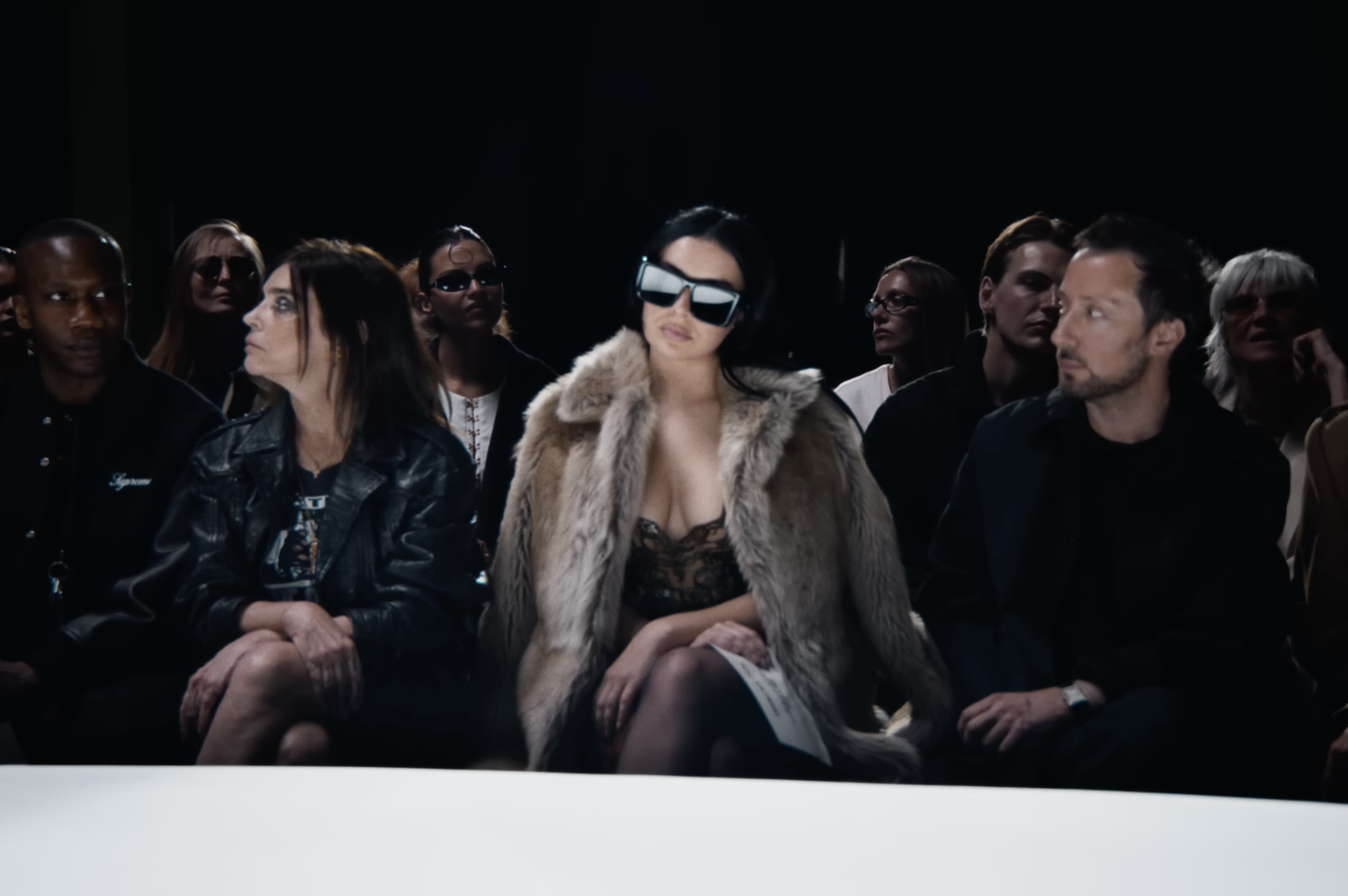
This is the case before the verdict. The album lands July 24; the ruling follows. What's below is written from three singles, one cover, and a title that tells you more than she probably meant it to.
Two summers ago, Charli XCX painted the world lime green and made it feel like a dare. Brat wasn't just an album, it was a permission structure — messy, confident, sweaty, the sound of a woman deciding the club was the center of the universe and inviting everyone in. She won the culture with it. For a year you could not escape that green. Now she has made a record whose title is a suicide note for the whole apparatus that green built. Music, Fashion, Film — the three things a person turns to for salvation, for glamour, for meaning — and the title is lifted from a lyric on "SS26" that finishes the thought with a knife: nothing's gonna save us. Not music. Not fashion. Not film. The three cathedrals of cool, named only to be told they won't hold.
That is either the bravest or the bleakest pivot in pop right now, and knowing Charli, it's both.
Start with the cover, because it's a thesis statement and she knows it. Three men, black-and-white: John Cale, Marc Jacobs, Martin Scorsese. One giant per discipline — music, fashion, film. Not peers, not collaborators. Elders. Charli, who two years ago was the youngest energy in the room, has surrounded herself with the old masters of the exact three forms her title says can't save us. It's reverence and refusal in the same frame. She's placing herself in a lineage and questioning whether the lineage means anything. That's a very Kovert move — refined face, feral doubt.
Then there's what she refuses to let you call it. The whole rollout has been dogged by "Charli's making a rock album," and she has swatted it down flatly: she never said that, she's said, and she finds the whole idea of thinking about genre in binary terms an old-school notion. Sit with the confidence of that. She released a lead single called "Rock Music" and then told you not to call the record rock. She named the thing after the trap and then refused to step in it. The three singles bear her out — "Rock Music" all noise and disjunction, "SS26" veering into restrained indietronica, "Wink Wink" clanging guitars over a mid-tempo strut with a video that turns household chores sexual and a caption that just said something horny is coming. Three singles, three sounds, one refusal to be pinned to any of them.
This is a woman who will not be made legible. And in 2026 — a year built entirely on making everything legible, taggable, sortable, served — that refusal is the most radical thing on the record before we've even heard it.
Here's where it collides with the other piece we ran this month, and why the timing is almost too perfect. Four weeks ago Madonna, at sixty-seven, released an entire album arguing that the dance floor is the antidote — that in a world engineered to isolate you, getting a body into a room to move is salvation, medicine, the cure that was never complicated. Run toward the floor, she said. It's the only thing that saves us.
And here is Charli, thirty-three, the person who built the last great dance floor, releasing a record whose title says the opposite in four words: nothing's gonna save us. Not the club, not the clothes, not the screen. Where Madonna runs toward the beat as rescue, Charli walks away from it convinced nothing rescues anyone — and makes the walking-away itself the art. Two women, the same exhausted year, the same overwhelmed feeling that A.G. Cook described as "so much, almost too much." Opposite responses. The elder's faith and the younger's disillusion, released three weeks apart.
You could read Charli's as the bleaker position. I'm not sure it is. There's a strange freedom in her version — if nothing's going to save you, then you're released from the obligation to be saved, and you can make whatever you want, refuse whatever label you want, put David Cronenberg on your closing track and call it "No One Lasts Forever" and mean it as a shrug and a liberation at once. Madonna says the dance floor frees you. Charli says the exit does.
So what's the record actually going to be? We don't know yet, and this piece won't pretend to. Eleven tracks, thirty-odd minutes, made with Cook and Finn Keane in the wreckage of being 2024's main character. Processed guitars, manipulated vocals, the lyrics reportedly circling her own tortured relationship with art itself — the aftermath of winning everything and finding the win hollow. It could be a masterpiece of controlled collapse. It could be a transitional record that reads better in five years than in five days. The singles have been divisive on purpose; the album may be a grower, or it may be the sound of an artist deliberately making herself hard to love because easy love is what the machine wants from her.
What we can say now is that it's the boldest bet in pop this summer: an artist at the peak of her cultural power betting that the way to keep it is to refuse to repeat herself, refuse the genre, refuse even the promise that any of this — music, fashion, film, the whole beautiful apparatus — will save a single one of us.
She's probably right that it won't. She's making it anyway. That refusal, held with total conviction, is the most Kovert thing any pop star will do all year.
The verdict comes July 24. Until then: nothing's gonna save us, and she wouldn't want it to.
Music, Fashion, Film is out July 24 on Atlantic Records. Details and quotations drawn from the public record, including Variety, Rolling Stone, and Vogue, plus the released singles "Rock Music," "SS26," and "Wink Wink." No lyrics are reproduced; song contents and the title's source lyric are described. Verdict to follow on release.
Obsessed: pending July 24. The bet is placed; the table hasn't turned over yet.