art · Nan Goldin
Nan Goldin Photographed Everything We Love Before It Had a Name
Nan Goldin's life's work — the intimate, dangerous, tender pictures she created — invented the way we see ourselves. Everything this magazine cares about, she photographed first.
By Damon King
"It's a way of touching somebody — it's a caress."
Before there was a single feed to perform for, Nan Goldin was already doing the opposite: making pictures that could only have been taken by someone who was in the room, in the bed, in the life. Not observing. Belonging. She said it herself, in the foreword to The Ballad of Sexual Dependency, and it remains the most useful sentence anyone has written about photography: "There is a popular notion that the photographer is by nature a voyeur, the last one invited to the party. But I'm not crashing; this is my party. This is my family, my history." That distinction — between the photographer who watches and the one who is entangled — is the whole reason her pictures still burn fifty years on, and it's why her retrospective, This Will Not End Well, which filled the Grand Palais this spring, was less a museum show than a walk directly into someone's nervous system. If you have paid attention to anything this magazine cares about — the dance floor as sanctuary, desire as an intelligence, the tenderness and danger that share a single frame, the queer underground as the place culture actually gets made — you have been looking at Nan Goldin's inheritance the whole time. She got there first. She photographed all of it before it had a name, and then the rest of visual culture spent forty years catching up and calling it a style.
Start where she started: The Ballad, the slideshow she first performed not in galleries but in downtown bars and clubs, loading a carousel projector against a soundtrack, showing what she called "the diary I let people read." Think about the radicalism of that venue. She didn't wait for the institution to validate her friends — the drag queens, the lovers, the beautiful wrecked bohemians of Provincetown and the Bowery and Berlin. She projected them on the wall of the room they were dancing in, and made the audience and the subject the same people. The Ballad is a chronicle of intimacy and coupling and the wild party, yes — but also of the bruise, the withdrawal, the friend who wouldn't survive the decade. Tenderness and violence in the same carousel. She never flinched from either, because flinching would have been a lie, and the one thing Goldin has never done is lie about what a life actually costs.
Then the series that should matter most to this magazine's readers: The Other Side, her decades-long homage to the trans women she lived among and loved beginning in the early 1970s — not photographed as subjects, as family. At a moment when trans lives are once again being legislated and lied about, a monumental museum honoring pictures made across fifty years of genuine belonging is not nostalgia. It's testimony. It's the receipt. Goldin documented a community the culture wanted invisible, with such tenderness that the tenderness itself became the argument.
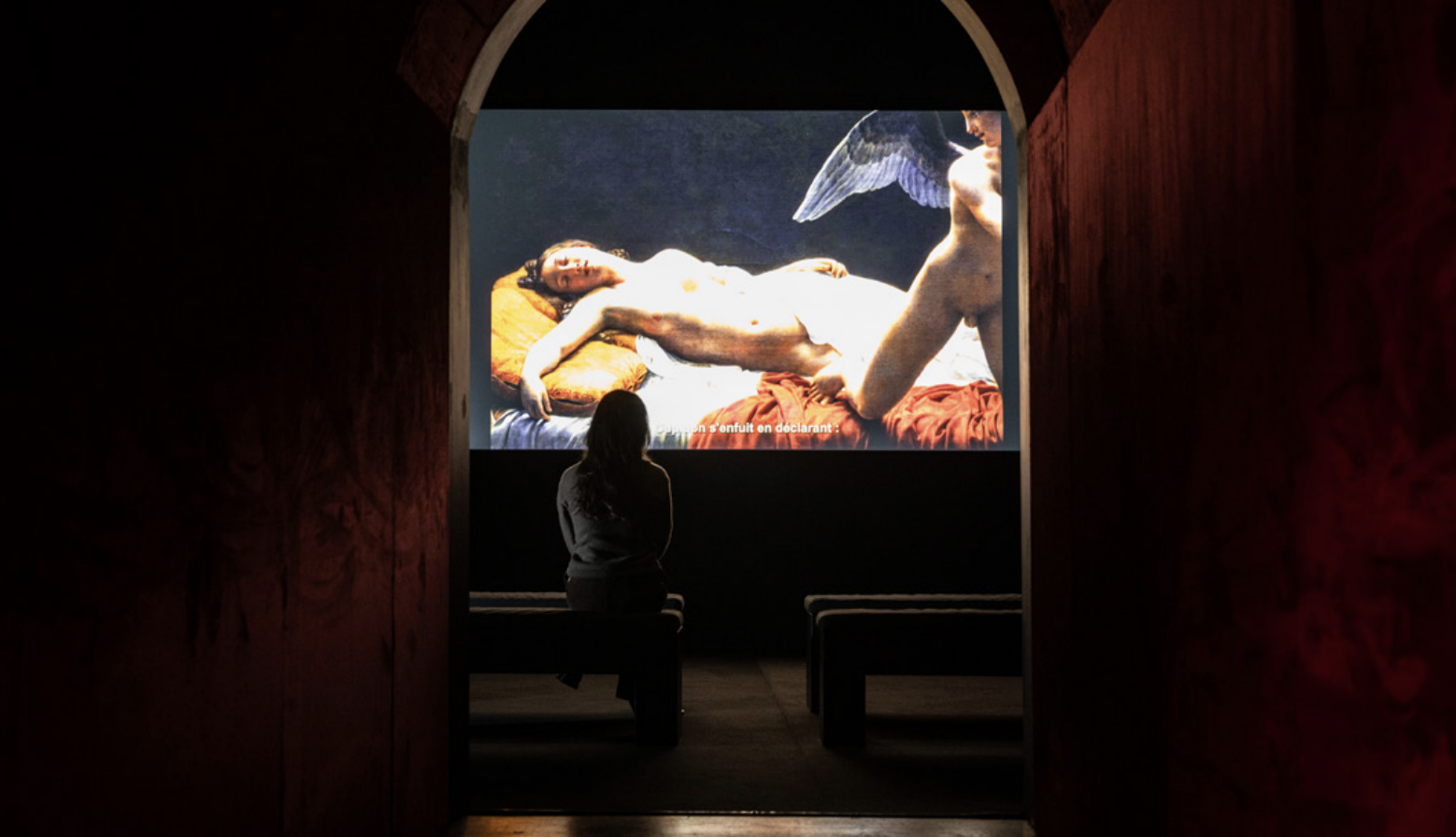
What a retrospective on this scale makes unmissable — and what keeps it from being a greatest-hits — is that Goldin was never really a photographer in the way we mean it. "I have always wanted to be a filmmaker," she says. "My slideshows are films made up of stills." She has told interviewers it was the eroticism and glamour of Antonioni's Blow-Up that put a camera in her hands as a teenager, and she's spent every year since turning stills into cinema: the projectors, the soundtracks, the constant reediting — she says she has never shown the same version of The Ballad twice. That restlessness is the practice, not a quirk of it. The work is never finished being made; it is only ever shown again, differently, by someone who has lived a little more since the last time. Which is why the show travels the way it does — Stockholm, Amsterdam, Berlin, Milan, Paris — and arrives each time as a different animal. Wardé builds it a village of rooms, dark bodies in a dim landscape, and rearranges them for every city; you move through it the way you move through grief, or a long night, or a love affair, and the route is never quite the route someone else took. Milan got eight slideshows in a black industrial void. Paris got five, in the salon above the Nef, and one that went across the river alone: Sisters, Saints, Sibyls — the work about her sister Barbara, who killed herself at eighteen when Nan was eleven, and whose suicide the family tried to hide — sent back to the chapel of the Salpêtrière, the old lock-up for women, where it was first staged in 2004 and where it has not been seen in its original form since.
And underneath all of it, the line that should be tattooed on the inside of every image-maker's eye. Goldin on why she shoots: "For me it is not a detachment to take a picture. It's a way of touching somebody — it's a caress." And then, because she is never content to leave you comfortable: "I think that you can actually give people access to their own soul." Sit with that against the way we make images now — extractive, performative, the camera as a weapon or a mirror or a cash register. Goldin's camera is a hand. The picture is contact. That is the entire difference between what she does and what the feed does, and it is why a room full of her forty-year-old snapshots will move you more than everything posted today combined. She wasn't capturing her friends. She was touching them, and letting you feel it secondhand, which is the closest thing to intimacy a photograph can offer.
She is seventy-two now, and she did not soften into the canonization. She spent the last decade waging open war on the Sackler family through P.A.I.N., forcing the museums that show her work to refuse Sackler money, turning the same unflinching gaze that made The Ballad onto the people who profited from the overdose deaths of people like the ones in her pictures. The woman who photographed addiction from the inside went after the architects of an epidemic and won — museum after museum scraping the name off the wall. And at the Milan press conference she walked in with something no one had been told about: Gaza, a silent film built from footage of the city before and during the war, looping, deliberately unfinished. Seventy-two years old, canonised on five continents, and still turning up with work that nobody asked her for and no institution can quite hold. That's the through-line of the whole life: the refusal to look away, and the refusal to let anyone else look away either.
Paris has closed. The doors shut on 21 June. But she isn't finished, and neither is the argument. In November she takes the Hayward — her first institutional show in Britain in more than twenty years — under a title she found in 1998 on a gravestone in a Lisbon pet cemetery: You Never Did Anything Wrong. Only Goldin could locate, on a dead animal's headstone, the sentence every picture she has ever taken has been trying to say to the person inside it.
She let us read her diary. The least we can do is learn how to see.
Nan Goldin: You Never Did Anything Wrong is at the Hayward Gallery, London, 24 November 2026 – 7 March 2027 — her first institutional exhibition in the UK since The Devil's Playground at the Whitechapel Gallery in 2002.
This Will Not End Well ran at the Grand Palais and the Chapelle Saint-Louis de la Salpêtrière, Paris, 18 March – 21 June 2026, the closing stop of a retrospective organised by Moderna Museet, Stockholm, which travelled to Amsterdam, Berlin, and Milan. The Paris presentation gathered The Ballad of Sexual Dependency, The Other Side, Memory Lost, Sirens, and Stendhal Syndrome at the Grand Palais, with Sisters, Saints, Sibyls at the Chapelle Saint-Louis de la Salpêtrière and the in-progress Gaza. Exhibition architecture by Hala Wardé. Quotations from Goldin's foreword to The Ballad of Sexual Dependency (Aperture, 1986) and from the exhibition's published English-language materials. Nan Goldin, b. 1953, Washington, D.C.