music · Kim Petras
Kim Petras and the Pop Machine That Demands to Be Fed
The only person who was ever in charge of Kim Petras is Kim Petras. It took the machine seven years and one Grammy to teach her that twice.
By Damon King
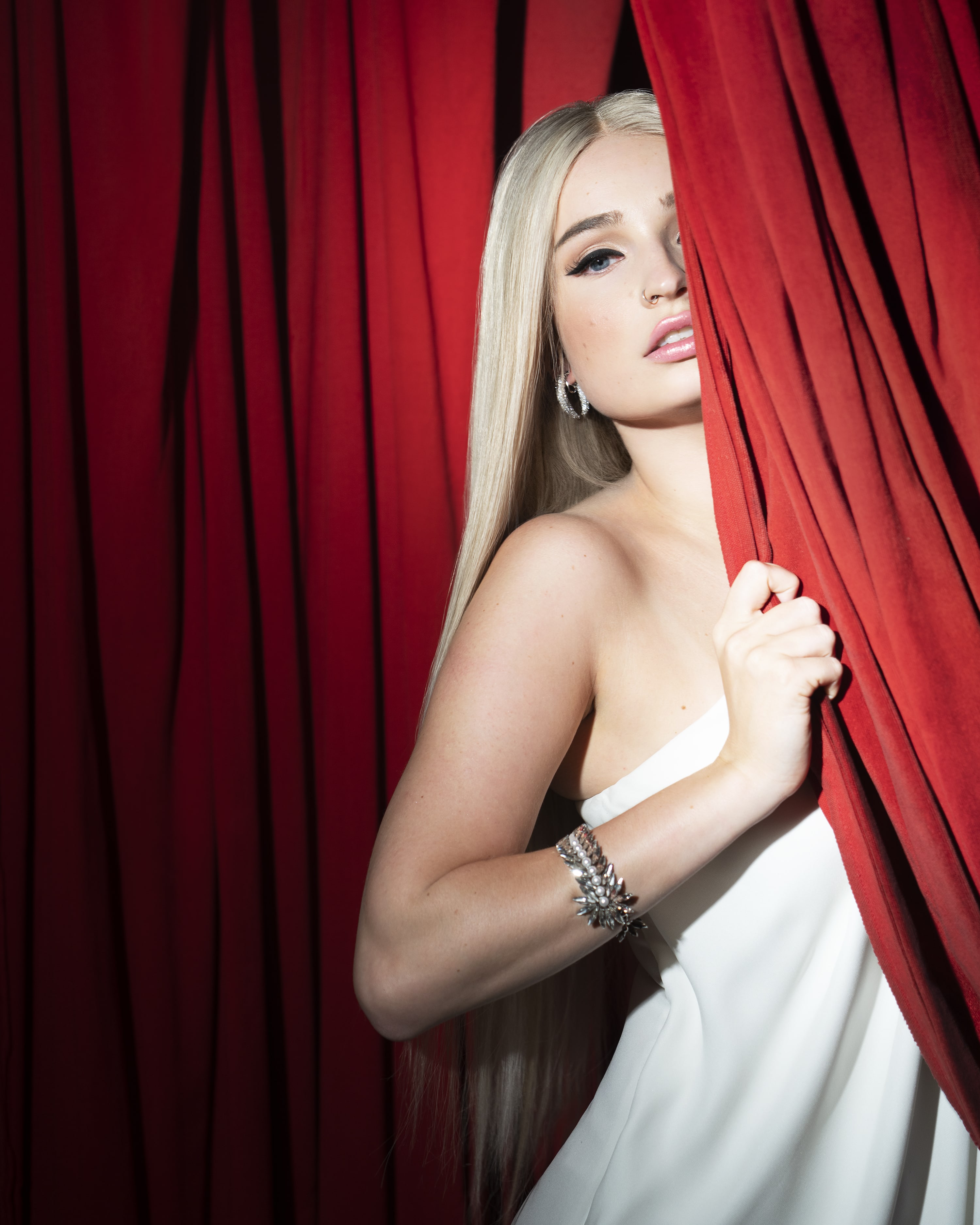
In 2019 I watched a twenty-six-year-old build a record label out of spite and call it survival. The story then was tidy, the way magazine stories are engineered to be tidy: platinum-blonde German girl, a hundred million streams, a sold-out European tour that vanished in minutes, a breakup album — Clarity — that she'd bled into over a season. We were supposed to file it under ingénue makes good. There was a headline floating around at the time about her single-handedly saving pop music. Reader, no one single-handedly saves anything. But she was doing something rarer than salvation. She was refusing to ask permission.
The detail that stayed with me — the one the glossy framing tried to hurry past — was the face. When Petras released her first single, "I Don't Want It at All," she pulled her own image off the cover and replaced it with a neon caricature. Not for art. For fear. "I didn't want people to look at me and say, 'Oh, I can see the male,'" she told me, "or think my forehead looked like a man's." She already knew the trap that waited for a trans artist walking into a boardroom: "I know from fighting for trans rights that that quickly becomes the only thing that people want to talk about."
So she erased herself to be heard. Sat in the machine's waiting rooms with what she called a "ridiculous level of self-confidence," and got told, over and over, some version of the same thing: We love the music. We can't sign you. We'd go to hell.
Her response was not to plead. It was to leave. She wrote songs for other people — Fergie, a Bratz soundtrack, a publishing deal at BMG — banked the money, and poured it into her own records. "That was always my goal," she said. "To get into the industry being a songwriter for other people and then doing a 180 once I knew enough people to do my own thing." She built BunHead in 2016 and put herself out into the world on her own terms, face or no face.
That was the story I published. I thought it was a story about arriving. It was a story about a door. And I didn't yet know she'd spend the next seven years learning what's on the other side of it.
Here is what happened after my recorder clicked off, and none of it is a secret — it is on the public record, in her own words, across every outlet that matters.
She signed to Dr. Luke's imprint in 2021. In 2022 she featured on Sam Smith's "Unholy," and the machine finally opened its jaws all the way: number one on the Hot 100, twenty countries, a Grammy for Best Pop Duo/Group Performance — the first openly trans woman to win in the category. The exact thing the boardrooms had told her was impossible, she now held in her hands, on a stage, thanking the trans legends who "kicked these doors open."
And then she told us what it was worth.
She named her 2023 album Feed the Beast — after the industry that had, in her telling, made her "suddenly successful," a phrase she delivers now with audible air quotes. "I hate that now all of a sudden everyone thinks I'm successful and before that I was apparently not," she told The FADER in 2026. "Even though I was selling out shows. I liked that a lot more." The full major-label fantasy — the Nicki feature, the ubiquity, the press tour that made her briefly inescapable — she has since described, flatly, as feeling "pointless." Sit with the shape of that. The woman who built her own label because the industry wouldn't have her, spent years fighting her way into the industry, got everything it promised — the hit, the trophy, the history — and found the room empty.
By 2026 she was begging to be let out of her Republic contract, which she says stalled Detour endlessly. She got out. It cost her — "the consequences are there," she says, and won't say more. And then she did the only thing that was ever really hers to do: she released the record independently, back under BunHead, funding her own videos with brand sponsors because that is what autonomy costs a pop artist now. "I'm just so happy that I can drop music," she said. "Even if I just get to put this album out, that feels like as much of a success to me as having a number one song or a Grammy."
Read that again. A Grammy winner telling you that putting the record out at all is the equal of the Grammy. That is not humility. That is a verdict.
This is why Kovert is running a body issue, and why Petras belongs in it. The story we're told to want is the frictionless one: the smooth ascent, the door that opens, the trophy that fixes you. Petras got the frictionless version handed to her — and discovered it was the actual prison. The friction was the freedom. Doing it herself, paying for it herself, saying no to the rooms she didn't want to be in — "not going to festivals or into rooms where I wouldn't go myself" — the resistance was where the self survived.
She told me in 2019 that she pulled her own face off a record so people would hear the music instead of interrogating her body. In 2026 she is, by choice, the most visible she has ever been about exactly what the machine costs — no caricature, no cover story, no one else in the credits deciding who she's allowed to be. The concealment was the survival strategy of someone who hadn't yet won. The exposure is the survival strategy of someone who has, and lived to tell you it wasn't the point.
The dance floor is dead, someone else said this year, so now we're making rock music. Petras said it quieter and earlier and with her whole career: the beast is always hungry, the beast is never grateful, and the only thing you actually own is whether you feed it. She fed it. It was still hungry. So she walked back out the door she built herself in the first place — the one nobody could sign, nobody could shelve, and nobody, it turns out, was ever in charge of but her.
Reporting from 2019 originally conducted by the author. Developments 2021–2026 drawn from the public record, including interviews with The FADER and Rolling Stone. All quotations as published.