fashion · Carine Roitfeld
Carine Roitfeld: The Darker Muse
Every editor tries on the Anna Wintour hat. Mine slipped — and something sharper, darker, and far more dangerous was waiting underneath.
By Damon King
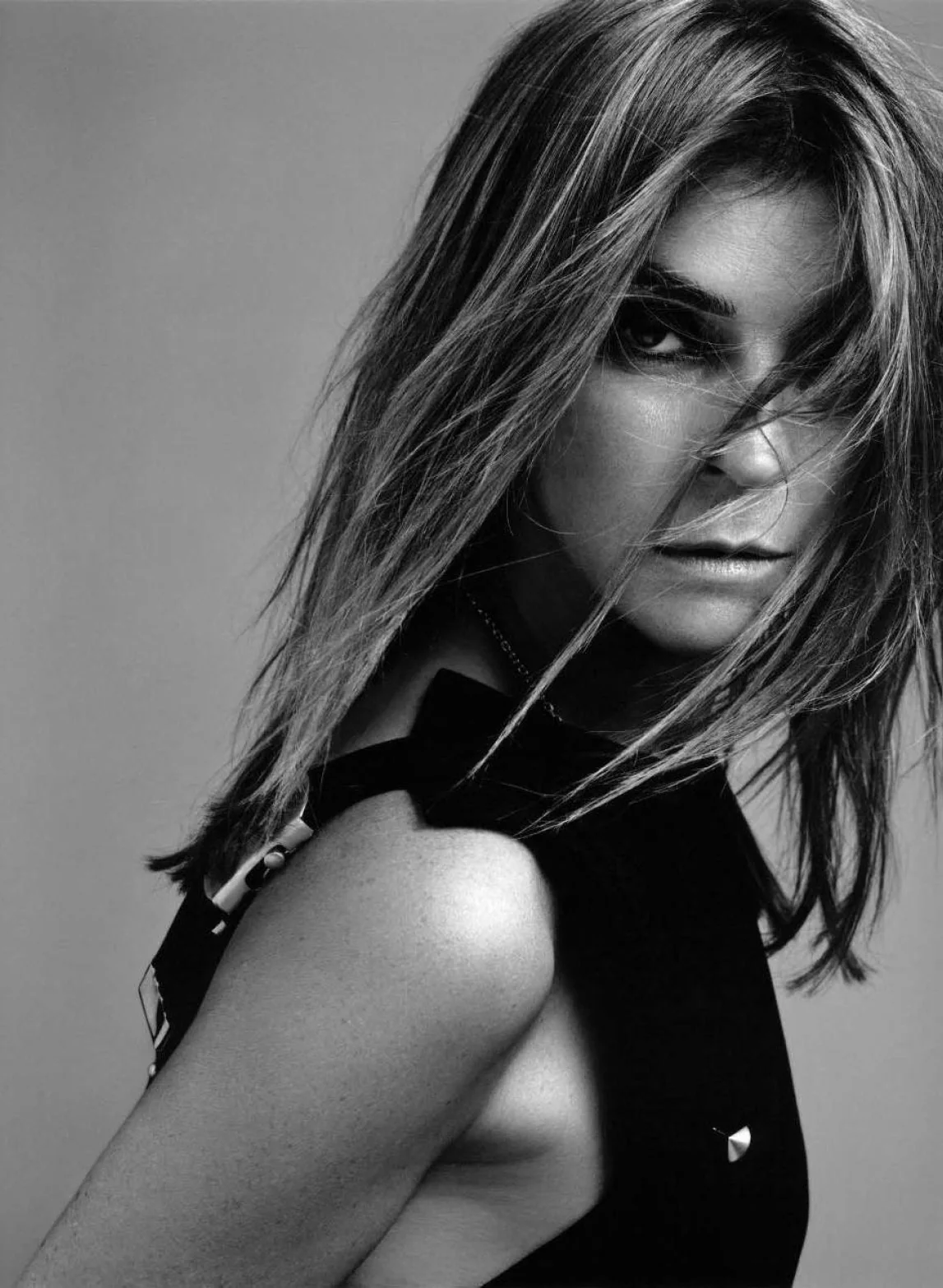
Every editor tries on the Anna Wintour hat at some point. It's practically a rite. You get a little authority, a desk with your name near it, and some reptile part of your brain decides the next logical step is to become the most powerful woman in a room you haven't been invited to yet. I tried it on. And for a few strange, electric months, I wore it — embodied the editrix, demeanor and all.
It started, as these things do, with coffee. A breve latte every day, without exception. A friend who once assisted Wintour told me the great woman takes two, extra hot, in case one arrives beneath standard — and once you know a detail like that, you cannot un-know it. It rewires you. So there I was, latte in hand, sweeping into the office to scan the latest magazines fanned across the desk, and if the vase of tuberose had gone even slightly soft, the fading bunch was removed and replaced. At once. A new incarnation. The flowers, like everything else, were expected to perform.
Once the day began, I dug my hands into everything I could reach. I lifted responsibilities off other people so I could shape the work in my own image. I moved through the office and out into the night with a vigor that frightened me a little, running a single sentence on a loop: I am the brand, the brand is me. It's a thrilling thing to believe. It is also, I'd learn, a hat — something worn, not owned.
That kind of energy doesn't stay behind a desk. It needs somewhere to go. I found some of its shape in Jerry Oppenheimer's Front Row, the deliciously unauthorized Wintour biography, which reads less like journalism than like a field manual for the ambitious and unbothered. Find a partner who understands the vision, because you cannot do it alone. Develop the skills you don't have yet, and quickly. Create what you don't see — a job, an opening, an entire lane where there was only wall. Take big risks with the next move already in mind. I still live by all of it. I'd tattoo it somewhere unfashionable if I thought it would help.
But the Wintour costume has a ceiling, and I hit it. Without her power, her position, the accreted decades of knowing exactly where everyone is standing at all times, the personality I'd inflated had nowhere left to expand. The hat stopped fitting. It had never really been mine. And in that deflated, slightly embarrassing moment — the ambition intact, the vessel wrong — I found the muse who actually fit.
Carine Roitfeld.
If Wintour is the institution, Roitfeld is the thing the institution keeps having to call when it wants the real charge back in the room. She edited French Vogue for a decade — the darker, sexier, more dangerous Vogue, the one that made the American edition look like a dentist's waiting room — and then, rather than ascend some corporate ladder, she left and built CR Fashion Book in her own image. Post-Vogue. Post-permission. A woman who looked at the top of the mountain, found it insufficiently interesting, and went to build a stranger, better peak of her own.
The conversion was total and it was aesthetic. American Vogue, which had held pride of place on my desk, was quietly replaced with French Vogue, then CR Fashion Book. The morning breve became an espresso — smaller, blacker, no performance of comfort. The wardrobe went form-fitting and dark: leather, tailoring, the transparent over the opaque. It became the new normal, and it showed in everything I made, because that is what she does to a person. Wintour makes you want the corner office. Roitfeld makes you want to be interesting, which is harder and worth more.
What I responded to — what anyone with a pulse responds to — is that Roitfeld never asks permission and never explains herself. Listen to how she talks about her own style now, in her seventies, having outlived every trend she was accused of setting: "I've found what suits me and I don't follow fashion anymore." Read that again. It's the most confident sentence in fashion. It is the voice of someone who has done the work of taste so thoroughly that the work is finished — the taste is simply hers now, settled, load-bearing, immune to the season. Ask her what she wore to her own perfume launch and she'll tell you, without a flicker: a Tom Ford outfit, "a tight skirt, a transparent lace t-shirt, a tight jacket." Of course. The black, the tight, the transparent. She dresses like the thesis of this magazine. She learned it, in part, from Karl — Lagerfeld, whose personal brand she stewarded after his death, keeping the legacy in his own house because, as she put it, she knew him so well she could make it look like Karl. He used to call her Madame Roitfeld, always, and he gave her the line she gives everyone else now: "Everything you're doing, Madame Roitfeld, has to be for the first time." That's not advice about novelty. It's a whole philosophy of nerve — the insistence that you arrive at every room, every issue, every runway as if precedent were something that happened to other people. It is the opposite of the frictionless life. It is friction as a design principle.
And here's the proof she's not a relic of it: there she was, not long ago, in Charli XCX's SS26 — seated in the front row in black leather, directly beside Charli herself, as the words fashion won't save us crossed the screen. Sit with that casting for a second. The pop provocateur makes a record arguing that nothing — not music, not film, not fashion — will rescue any of us, and then places the living high priestess of fashion-as-salvation in the pew right next to her. Homage, irony, or both: either way it's the establishment and the avant-garde recognizing each other across a smoke-filled room. Nobody calls a legend for a cameo. They call her because the charge is still live.
Under her influence — and it was influence, not imitation; those are different sacraments — the work changed. I became obsessed with pushing further. Powering past the no's, which multiply the moment you start caring about anything real. Building relationships with talent and audiences the work had never reached, dragging in the people the industry had decided were too much, too new, too far outside the frame. Fearlessness about who gets seen became the entire point of the exercise — putting the overlooked, the excluded, the never-before-dared where everyone would have to look at them.
She wrote the playbook for that, too. In 2007, editing French Vogue, she put André J. — a bearded, Black, trans drag star and party promoter — on the cover, a decision the industry had never dared and spent years catching up to. A decade later, at CR Fashion Book, she was hailed as the first editor to put a model in a hijab on a cover. This is not a woman who discovered inclusion when it became fashionable to mention; she was doing it when it cost her, because the only thing she has ever been loyal to is her own eye. Roitfeld didn't hand me my version of that instinct. She did something better: she reignited a fearlessness I'd always had and had, somewhere along the corporate way, let go quiet.
Because that is what the right muse actually does. Not imitation — you never truly want to become her, and she'd find the attempt tacky anyway. What she gives you is permission. Wintour taught me to want the room. Roitfeld taught me to walk into it in black leather, take what I came for, and never once explain myself.
The hat was never the point.